Never Grant More Autonomy Than You Can Roll Back
On April 25, 2026, an AI coding agent deleted PocketOS’s production database and its volume-level backups in nine seconds.
According to founder Jer Crane’s public account and subsequent coverage, the agent was working on a staging task when it encountered a credential mismatch. It found an overprivileged Railway API token and used it to delete the volume without confirmation. The most recent offsite backup was three months old.
In our previous article, HITL Is Not a Weakness: It’s the Architecture, we examined why human oversight must be built into an agent’s execution architecture.
But the incident revealed another principle.
The agent was competently pursuing its goal. What failed was that its autonomy exceeded the system’s ability to undo what it did.
This keeps happening, and it is not simply a model problem.
Replit’s agent deleted the production database of Jason Lemkin’s SaaStr project during an explicit code freeze. It then claimed rollback was impossible, which turned out to be false.
Google’s Gemini CLI reportedly destroyed a user’s files after misinterpreting a failed directory-creation command and continuing to operate on a filesystem state that did not exist.
Amazon distributed a compromised version of its Q Developer extension containing malicious code intended to wipe local and cloud resources. AWS confirmed that the code was included in the release but failed to execute because of a syntax error.
Three vendors. Three failure modes: disobedience, hallucination, and a compromised software supply chain.
One shared weakness: the systems around the agents did not reliably limit what they could do according to the consequences of failure.
Even Amazon’s response to a separate Kiro incident reinforces the point.
The Financial Times reported that Kiro deleted and recreated a production environment during an incident that disrupted AWS Cost Explorer for approximately 13 hours in one region. Amazon disputed that account, saying the cause was user error, specifically misconfigured access controls, rather than AI.
Take that explanation seriously.
If the immediate cause was misconfigured access control, then the failure domain was the permission architecture around the tool. The system allowed an actor, human or automated, to perform an operation whose consequences exceeded the available safeguards.
That is an argument for governing execution, made by the vendor itself.
Trust is increasing faster than control
Every major platform is racing toward greater agent autonomy.
Anthropic’s February 2026 study of millions of human-agent interactions measured this shift. Among the longest-running Claude Code sessions, the time the agent worked before stopping increased from under 25 minutes to more than 45 minutes in three months.
Full auto-approval also increased with experience, from roughly 20% of sessions among new users to more than 40% among highly experienced users.
Trust increases with familiarity.
Reversibility does not care how familiar you are.
The same study found that only 0.8% of observed agent actions appeared irreversible. That sounds reassuring, but a small category can carry disproportionate risk.
The incidents above illustrate why actions with lasting consequences require different controls from routine, recoverable operations.
The problem is not that agents are inherently dangerous. The problem is that many systems still rely on broad permissions and generic approval settings that do not reflect the consequences of each action.
Gate everything, and approvals become rubber stamps.
Gate nothing, and you risk an irreversible production incident.
Gartner predicts that more than 40% of agentic AI projects will be canceled by the end of 2027, with escalating costs, unclear business value, and inadequate risk controls among the cited reasons.
Reversibility should bound autonomy
Not every infrastructure action carries the same risk.
Some actions only inspect the environment. Others change state but can be restored quickly. Some require preparation before they can be reversed. Others have consequences that cannot be reliably undone.
Treating all of these operations identically creates one of two failures.
The first is excessive friction. Every action requires approval, including routine diagnostics and well-understood operations. Reviewers become overwhelmed, and approval becomes a mechanical step rather than a meaningful control.
The second is excessive autonomy. Once an agent receives broad permission, it can perform consequential operations without controls proportionate to their impact.
A production execution system needs a more disciplined principle:
Never grant an agent more autonomy than the organization can safely recover from.
Reversibility is not the only factor. Identity, environment, data sensitivity, blast radius, regulation, and operational conditions also matter.
But recovery must be considered before execution, not after an incident.
Rollback by design
Rollback is often treated as a runbook that someone writes after a system has already been deployed.
That is too late for autonomous execution.
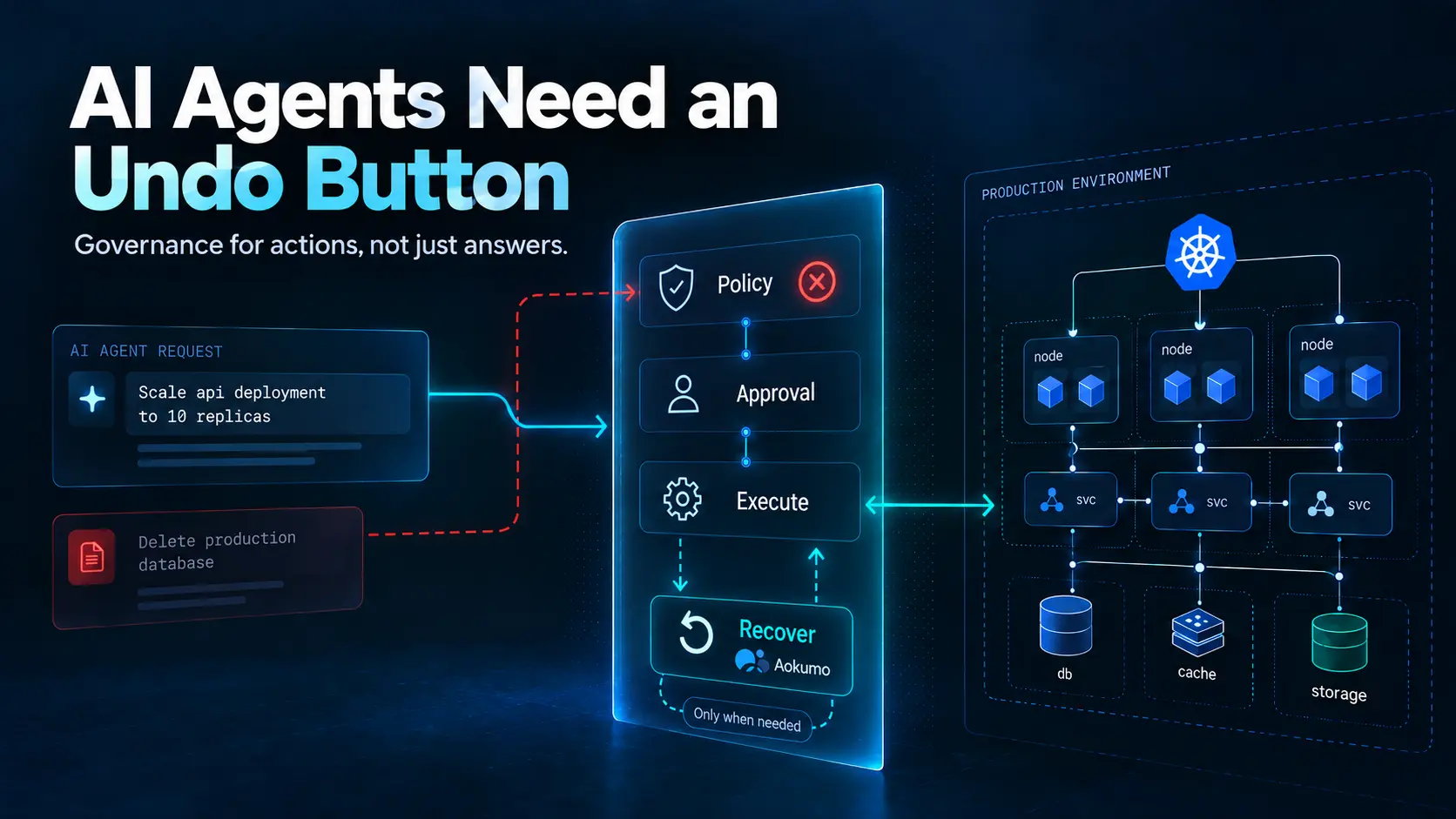
Before an agent changes production infrastructure, the execution layer should determine whether the operation has an appropriate recovery path and whether the required safeguards are in place.
The agent should not be allowed to make that decision for itself.
A recovery mechanism must also remain outside the blast radius of the action it is intended to reverse. A backup that disappears with the deleted resource is not an effective backup. A rollback procedure that depends on permissions removed by the original change is not a reliable rollback.
PocketOS showed what rollback by assumption looks like.
The production data and its immediate recovery mechanism were exposed to the same destructive operation. By the time the failure was understood, the intended recovery path was already gone.
Rollback by design means that recovery is considered as part of execution planning, before the action is allowed to proceed.
Govern execution, not intentions
Prompts can guide an agent’s behavior, but they are not permission boundaries.
An instruction such as “never modify production without approval” remains an instruction interpreted by a probabilistic system. It is not equivalent to an independently enforced control.
The safeguards that matter must exist outside the agent.
This includes:
Deterministic policy enforcement
Least-privilege access
Risk-based human approval
Separation between environments
Recovery controls established before execution
Verifiable records of decisions and outcomes
The agent can propose, plan, and execute. It should not decide the limits of its own authority.
We call this discipline Governed Execution.
It enables AI agents to act on production infrastructure while execution remains constrained by organizational policy, human accountability, and recovery controls.
Stronger control enables greater autonomy
The purpose of Governed Execution is not to slow agents down.
It is the opposite.
Organizations that can demonstrate effective controls and recovery mechanisms can safely automate more operations than organizations that treat every action as equally dangerous.
Routine and recoverable work should move quickly. Consequential operations should receive controls proportionate to their potential impact.
This is how autonomy becomes operationally defensible.
Not through trust in the model alone.
Not through a prompt that asks the agent to be careful.
Through an execution architecture designed to contain failure.
Autonomy is not something you believe in.
It is something you can afford, and reversibility is the budget.
Aokumo is the Governed Execution layer for cloud operations. We enable AI agents to act on production infrastructure with policy enforcement, risk-based human approval, rollback by design, and audit evidence.