What Is Governed Execution?

AI agents are beginning to act on production systems.
They can deploy software, modify infrastructure, change configurations, restart workloads, and call operational APIs. The question is no longer only whether an agent can determine what to do. It is whether an enterprise can retain control over what the agent is allowed to make real.
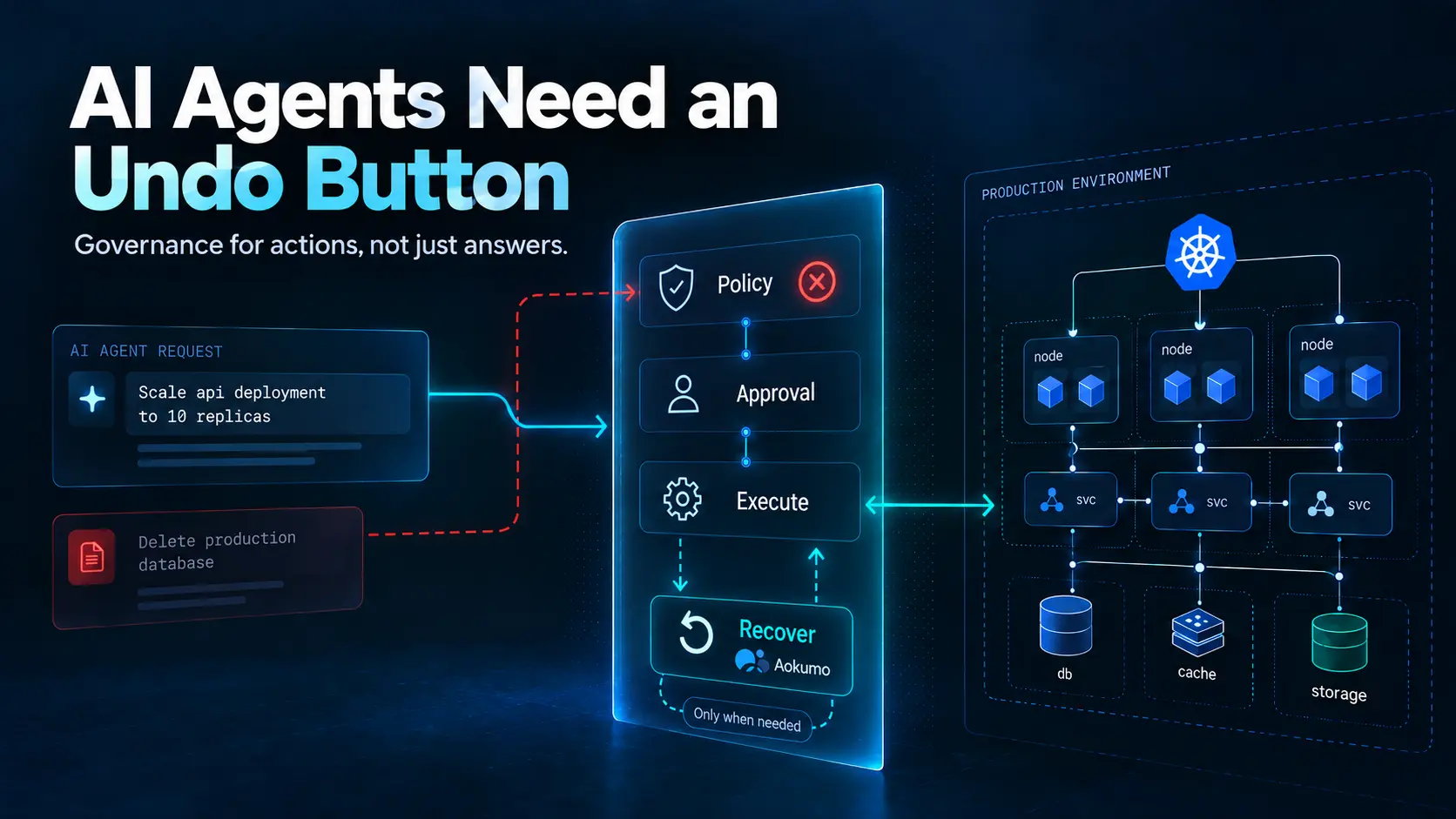
Governed Execution is the discipline of allowing AI agents to act on production systems only within enforceable organizational boundaries.
It is not a review process added around an agent. It is a property of the path through which the agent acts.
The distinction matters because an agent’s ability to perform an operation does not give it organizational authority to perform that operation. Capability belongs to the agent. Authority must remain with the enterprise.
From intelligent decisions to authorized actions
Most discussions about AI governance focus on what models say: whether their output is accurate, appropriate, safe, or compliant.
Those questions remain important. But they are not sufficient when agents can operate tools and change real systems.
A model can produce perfectly acceptable language while performing an unacceptable operation. Nothing destructive needs to be said for something destructive to be done.
Governed Execution addresses the point at which an agent’s decision becomes an action.
It separates two questions that are often treated as one:
What does the agent propose doing?
What is the organization prepared to allow?
The agent can answer the first question. It cannot confer authority on itself to answer the second.
Prompts are not authority
A system prompt might tell an agent:
Do not modify production without approval.
That instruction may influence the agent’s behavior. It does not independently enforce the organization’s authority.
Prompts are interpreted by probabilistic systems. Their effect can change with context, competing instructions, model behavior, or malicious input. They are valuable for guidance, but they are not equivalent to an organizational boundary.
A policy document has a similar limitation. It can describe what should happen without ensuring that the execution path follows it.
Governed Execution requires the organization’s rules to remain effective even when the agent is wrong, overconfident, confused, or manipulated.
The practical test is simple:
Can the agent perform the action without passing through the organization’s authority?
If the answer is yes, the action may be documented or supervised, but it is not fully governed.
The action is the unit of governance
Enterprises commonly grant users, applications, and services access to systems through identity and permissions. AI agents need those controls too.
But an agent’s identity alone does not describe the complete risk of an operation.
The same agent may investigate an incident, restart a workload, modify an access policy, or delete data. Those actions do not carry the same consequences and should not inherit the same level of autonomy merely because they originate from the same identity.
Governed Execution therefore treats the action—not the agent—as the unit of governance.
Organizational authority should follow the potential consequence of the action and the enterprise’s ability to recover. It should not follow the agent’s confidence in its own recommendation.
This is already how serious organizations govern decisions involving money, access, legal commitments, and production changes. Greater consequences require stronger authority.
Governed Execution applies the same principle to actors that operate in seconds rather than meetings.
Human involvement should remain meaningful
Governed Execution does not mean placing a person in front of every operation.
If every investigation, diagnostic query, routine restart, and temporary action requires approval, the queue becomes unmanageable. Reviewers stop exercising judgment and begin pressing buttons. Approval remains visible but loses its value.
Removing human authority entirely creates the opposite problem: an autonomous decision can produce consequences beyond the organization’s ability to contain.
The objective is to preserve human judgment for the situations in which it is valuable.
Routine work should move quickly. Consequential actions should receive authority appropriate to their potential impact. The precise implementation will vary by organization, environment, and risk tolerance.
Governed Execution is therefore not a rejection of autonomy. It is what makes greater autonomy defensible.
Recovery defines the safe boundary of autonomy
The confidence of an AI model does not make an operation easier to reverse.
Backups may be unavailable. Snapshots may take hours or days to restore. A recovery operation may discard legitimate changes, affect unrelated systems, or fail because the surrounding environment has changed. Some actions cannot be cleanly reversed at all.
For that reason, an enterprise should not grant autonomy based only on whether an agent is likely to make the correct decision.
It must also consider what happens when the decision is wrong.
Governed Execution keeps autonomy within the organization’s demonstrated ability to detect problems, limit their impact, and recover.
This does not require every operation to have a perfect undo mechanism. Production systems do not work that way. It requires the limitations of recovery to be understood before the organization relies on autonomy.
The governing principle is straightforward:
Never grant more autonomy than the organization can safely recover from.
Execution must remain explainable
Traditional logs usually answer: “What happened?”
Autonomous execution creates additional questions:
Why was this action allowed?
What organizational authority applied?
Was human judgment required?
Who or what authorized the execution?
What was the result?
An enterprise should not have to reconstruct these answers afterward from chat histories, disconnected tickets, and the memories of engineers.
As autonomy increases, execution must remain attributable and explainable.
Governed Execution therefore connects action and accountability. The organization must be able to explain not only what the agent did, but why the action was permitted to occur.
This is the difference between observing activity and demonstrating control.
What Governed Execution is not
Governed Execution is not content filtering. Content controls evaluate what models receive or produce. Governed Execution concerns what agents are permitted to do.
It is not monitoring or AIOps. Observability can describe system behavior without possessing authority over the next action.
It is not an approval button added to a chat interface. Approval has value only when the required authority cannot be bypassed.
It is not identity and access management alone. Permissions remain essential, but a technically authorized action can still be inappropriate under the circumstances or carry unacceptable consequences.
It is not policy enforcement alone. Permission does not automatically establish proportional authority, operational recoverability, or accountability.
Each of these capabilities can contribute to safer systems. Governed Execution describes what happens when organizational authority becomes an inseparable property of the path through which an AI agent acts.
Why now?
AI agents are moving from generating recommendations to operating tools and production systems.
At the same time, users tend to grant agents greater freedom as familiarity grows. Anthropic’s research on agent autonomy found that experienced Claude Code users were more likely to use automatic approval, while the longest uninterrupted agent sessions increased substantially over a period of several months.
Trust grows through familiarity. Operational consequences do not become smaller because users feel more comfortable.
This creates a widening gap: agents can act for longer, users supervise them less, and many enterprise controls still assume that a person initiates each consequential change.
Governed Execution addresses that gap.
The principle itself is not new. Enterprises already understand change control, separation of duties, least privilege, accountability, and recovery planning.
What is new is the speed and independence of the actor to which those principles must now apply.
Retaining enterprise authority
Governed Execution begins with a clear separation:
The agent determines what action to propose. The enterprise retains authority over what is allowed to become real.
That authority cannot exist only in a prompt, policy document, or approval ceremony. It must remain effective at the moment of execution.
This is the foundation for using AI agents in production without surrendering operational control.
The objective is not to slow agents down. It is to make their autonomy sustainable.
The agent proposes the action. The enterprise decides what becomes real.
Aokumo provides governance software for AI agents that operate cloud infrastructure, helping enterprises introduce production automation without losing control.
Source