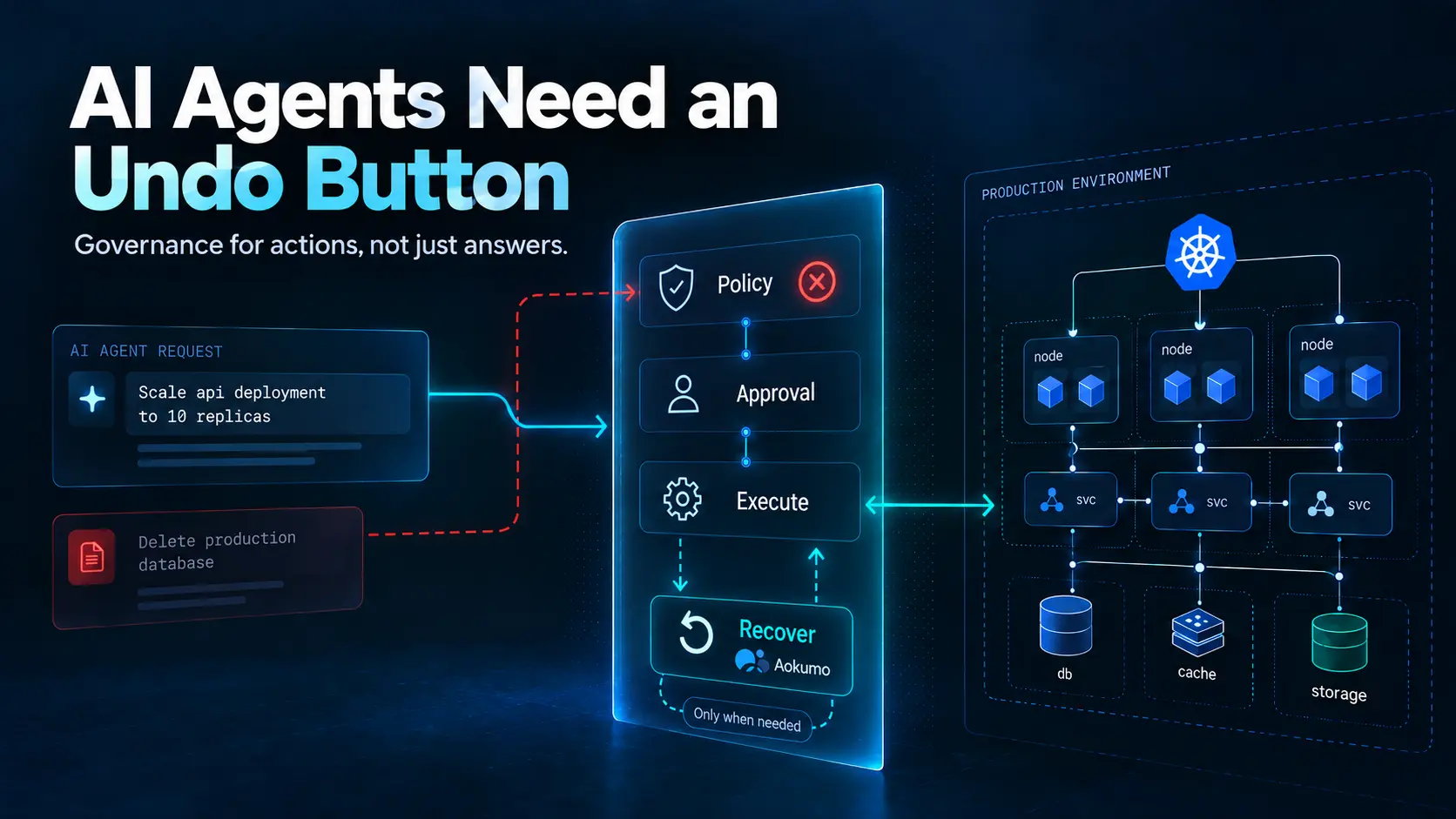
What Is an AI Agent Execution Layer?

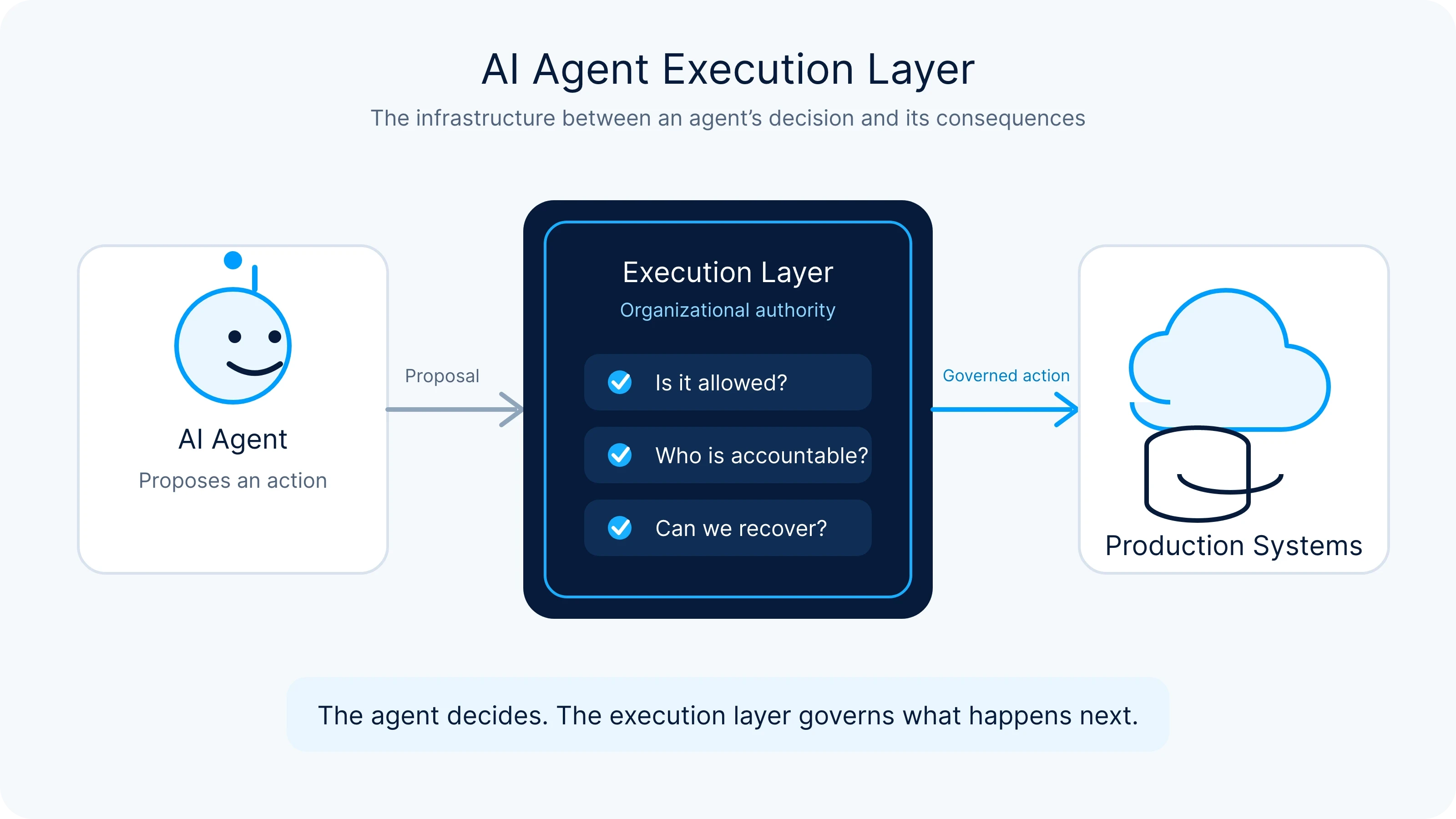
An AI agent execution layer is the infrastructure that sits between an agent's decision and the system it acts on. A complete one keeps credentials and organizational controls outside the agent, routes consequential actions through accountable authority, establishes the recovery position before an action runs, and preserves evidence of what occurred.
In one sentence: the agent decides, the execution layer governs what happens next.
This page defines the term as we use it, what the layer does, what it is not, and how to tell whether you already need one.
Why the layer exists
Every useful agent eventually acts on a real system: it closes the ticket, posts the journal entry, changes the configuration, moves the money. At that moment, three questions decide whether the organization is in control, and none of them are about the model.
Is this action allowed? Who is accountable for it? Can we recover if it is wrong?
Today, most deployments answer those questions inside the agent itself: a system prompt that says "always ask before destructive changes," a credential with broad standing permissions, a settings toggle for auto-approval. These controls may influence the agent, but they do not independently constrain the execution path. Instructions can be misunderstood, overridden, or bypassed as context, permissions, and integrations change.
That is no longer a contrarian position. AWS made policy evaluation for Amazon Bedrock AgentCore generally available in March 2026, operating outside the agent's code and evaluating agent-to-tool requests before access is allowed or denied. Microsoft has introduced dedicated agent identities in Entra with lifecycle governance and accountable human sponsors. OWASP's Q1 2026 exploit round-up describes the same year from the other end: a transition from theoretical risk to real exploitation, in which misconfigured permissions, excessive autonomy, and weak validation produced data exfiltration and remote code execution against live systems.
The execution layer exists because those three answers have to live somewhere an agent's language cannot reach. Below the agent. In infrastructure.
What an execution layer does
Whatever the implementation, a credible execution layer has to address a connected set of responsibilities. Each gets a full argument of its own in this series; here is the map.
Execution policy. Permission comes from architecture, not prompts. The layer evaluates every proposed action against policy enforced outside the agent, so the difference between "may" and "may not" survives any conversation. An instruction can be argued with. Independently enforced policy does not change because the agent disagrees.
Execution identity. Every action is attributable to a known agent and an accountable organizational authority. The agent remains distinguishable even when acting on behalf of a human, and delegation between agents should not break the chain of accountability. If you cannot determine which agent performed an action and under whose authority it acted, you cannot govern it.
Execution recovery. Consequential actions are checked for a way back before they run, not after they fail. This does not require a perfect undo for every operation, because production systems rarely offer one. It requires the organization to understand its recovery position before autonomy depends on it. Never grant more autonomy than you can roll back.
Execution verification. "The agent said it did it" is never the only evidence that it did. The layer checks the observed result against the target system rather than relying on the agent's account of its own success. The action is not complete when the command returns. It is complete when the expected state has been confirmed.
Execution audit. Acting produces evidence, not just logs. A consequential action should leave a record connecting the action, the authority that permitted it, the approval where one was required, and the observed result, generated as a by-product of execution rather than assembled afterward. Logs prove activity. Evidence proves control.
Risk-based approval. Human judgment is part of the layer's architecture, not a courtesy setting. Putting a person in front of every action does not produce control; it produces approval fatigue, and approval fatigue ends in rubber-stamping or blanket auto-approval. Attention should be reserved for the actions whose consequences justify it.
What an execution layer is not
It is not a sandbox or agent runtime. A wave of strong engineering is replacing raw shell access with typed runtimes and millisecond-fast isolates, and it deserves the attention it gets. But isolation protects the host from the agent's code. A perfectly sandboxed agent holding valid credentials can still delete a production database, because the danger was never where the code ran. The runtime governs where code executes. The execution layer governs what the action does to the systems that matter.
It is not the agent framework. Orchestration frameworks decide how agents think, plan and call tools. The execution layer governs what happens when a proposed action meets a real system. A framework is inside the agent's world. The layer is outside it, which is the point.
It is not observability. Monitoring and AIOps tell you what is happening and what broke. They watch. The execution layer governs the action taken in response. We have argued elsewhere that watching is no longer enough.
It is not IAM alone. Identity and access management establishes who or what may access a resource and which operations that identity may perform. Modern IAM can be highly dynamic, using conditional access, session policies, and just-in-time elevation. Even so, it does not independently determine whether a particular action is appropriate under the circumstances, whether additional organizational authority is required, or whether the enterprise can recover from the result. Valid credentials prove technical authorization. They do not prove operational appropriateness.
It is not policy enforcement alone. This is the distinction that matters most in 2026, because policy is the part of the problem the platform vendors have shipped first. A gateway that intercepts agent-to-tool calls and evaluates them against declarative rules answers the first question well: is this action allowed. It does not answer the other two. It does not establish whether a way back exists before the action runs, it does not decide which named human owns the consequence, and it does not check the target system afterward to confirm the intended outcome actually occurred. Allow-or-deny at the boundary is necessary and it is not the whole layer.
It is not guardrails. Content filters and safety prompts shape what an agent says and decides. They live above the action, in the instruction layer. The execution layer assumes the instruction layer can fail, because it can, and holds the controls that survive that failure.
It is not a Trusted Execution Environment. TEEs protect computation from the host through hardware isolation. An execution layer governs the consequences of an agent's actions on other systems. Complementary, unrelated problems.
Do you need one?
A short test. If your organization runs agents anywhere, ask:
Can any agent reach a production system with a credential that outlives the task it was granted for?
If an agent proposed a destructive action right now, would anything other than its own instructions stop it?
Could you produce a record of last month's consequential agent actions showing why each was permitted, who approved it where approval was required, and what result was observed?
Does an agent's autonomy rest on how much its operators trust it, rather than on what the action would cost if it were wrong?
Every uncomfortable answer marks a place where your agents are operating on trust, and trust is not a control. Trust is a reasonable basis for letting an agent investigate. It is not a basis for letting one act.
Where this is heading
As agents gain access to more tools and production systems, execution governance will move from an optional safeguard to a standard enterprise control. NIST's AI Risk Management Framework already organizes expectations around governing, mapping, measuring, and managing AI systems across their lifecycle. Risk, security, and audit teams will increasingly expect organizations to demonstrate why consequential agent actions were allowed and who remained accountable for them.
Every new agent connected to a production system makes the ungoverned version of the question more expensive.
Why would any enterprise let an AI agent execute without an execution layer?
Govern what happens next
Aokumo provides governed execution for AI agents operating cloud and Kubernetes environments. It helps enterprises apply enforceable policy, risk-based human approval, recovery controls, and audit evidence to production automation.
The agent decides. Aokumo governs what happens next.
Related reading:
Never Grant More Autonomy Than You Can Roll Back
What Is Governed Execution?